
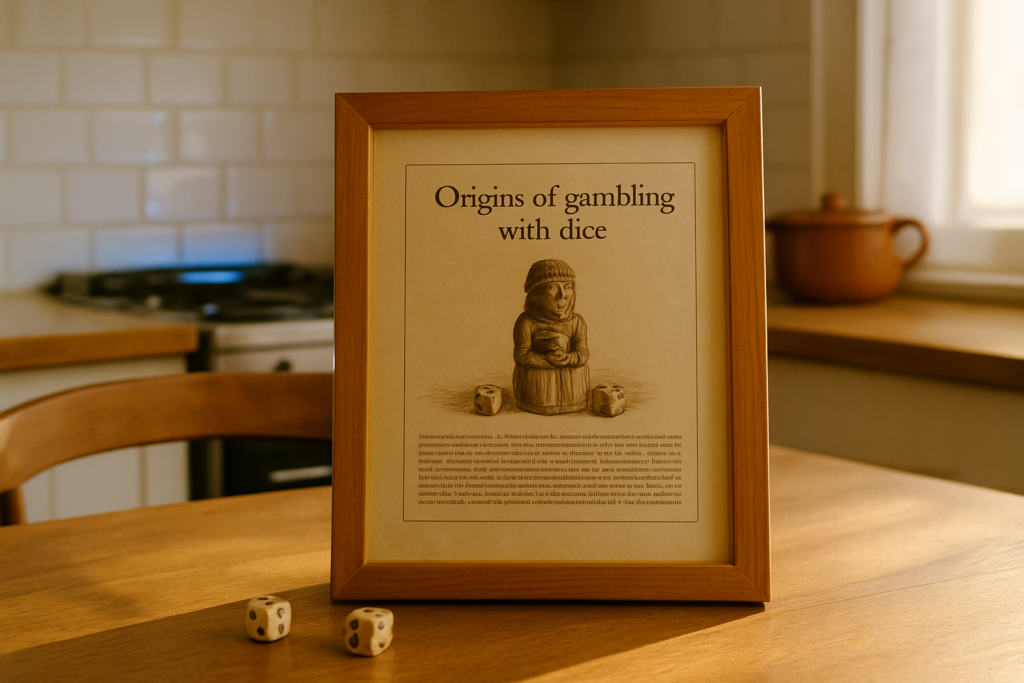
Ancient Origins of Dice
Dice have been part of human culture longer than most tools still in use today. Archaeologists have traced their history back over 5,000 years to the dusty floors of Mesopotamian tombs and Egyptian burial sites. These weren’t always the polished cubes we know now early dice were often made of bones, stones, ivory, or clay, carved or chipped by hand, and balanced only in the roughest sense of the word.
Back then, dice weren’t just a game mechanic. They were more than entertainment they carried spiritual weight. Many were used in divination rituals, tossed to interpret the will of gods or ancestors. In some cultures, your fate might have been decided by a simple throw. Others used them in early games of chance, where competition and luck started blending into something recognizably close to what we now call betting.
Whether used to tell fortunes or entertain pharaohs, dice were early humans’ way of parsing chaos. And they’ve stuck with us sliding from sacred ritual to street game, from temples to casinos.
Explore the origins of dice betting
Dice and the Birth of Gambling Culture

Long before roulette wheels and online sportsbooks, the foundations of gambling were cast literally with dice. Early civilizations didn’t just roll dice for entertainment; there was always something riding on it. In ancient Greece and Mesopotamia, dice were already being used to wager food, goods, and even status. The connection between dice and risk wasn’t a coincidence it was the natural outcome of humans tying chance to consequence.
By the time the Roman Empire hit its stride, dice games were everywhere. Soldiers in military camps tossed dice between campaigns, betting rations or coins. Market stalls turned into informal betting hubs, with traders and townsfolk alike placing quick bets between business deals. What started as simple pastime evolved into a system where outcomes had real stakes.
As play merged with profit, dice didn’t just entertain they shaped behavior. Humans began to crave the thrill of fast wins and sharpened the instinct to read odds. That fundamental switch from game to gamble laid the groundwork for modern wagering. The appeal was ancient, the psychology enduring: with dice, you didn’t just throw for fun anymore. You threw because winning meant something.
Global Influence on Modern Betting
Dice may look simple, but their mechanics have had a deep impact on how people bet. The basic principle random number generation within fixed odds laid the groundwork for early betting systems. From street corners to saloons, people shaped strategies around the roll of the dice, trying to predict patterns, calculate odds, and outsmart chance. This tinkering gave rise to structured systems like the Martingale and Paroli, originally built around dice games before spreading into broader gambling.
Craps, as we know it today, evolved from Old English games like Hazard. With time, the rules were tightened, formats standardized, and the game made its way into casinos. Thanks to its fast pace and social energy, craps became a gambling staple, especially in the United States. But beneath that surface noise is probability theory at work complex enough to inspire gamblers and mathematicians alike.
In fact, dice games helped push the early study of probability into mainstream thinking. Gamblers wanted an edge, and mathematicians like Pascal and Fermat responded with formulas that later powered modern statistics. Psychologically, dice also tap into risk perception people overestimate their control of random outcomes, a trait casinos quietly profit from. Simple dice, complex consequences.
Legacy and Cultural Impact
Thousands of years later, dice still haven’t lost their edge. There’s something primal and satisfying about a small cube deciding your fate. Whether it’s the clatter across the felt or the tap of a button in a mobile app, dice games keep their place because they’re simple, unpredictable, and rooted in tradition. Even as casinos and platforms go digital, the essence remains: fast results, clear odds, and wild swings.
Online platforms have stepped in not just to replicate the experience, but reimagine it. Virtual dice tables, live streamed rolls, and blockchain based randomness bring new layers to the old game. Some platforms even let you customize the design of your dice or simulate rare historical variants bringing the past into the present with a modern twist.
Beyond entertainment, dice remain a surprisingly effective way to teach probability. Understanding that a six sided die has fixed odds grounds everything from poker strategy to mathematical modeling. For new players and seasoned bettors, dice still offer a gateway to grasping risk, managing emotion, and making informed decisions under pressure.
Go deeper into the origins of dice betting
 Aaron Delvalle is the insightful author behind Gamble Wise Roots, where he brings a fresh perspective to the world of gambling. His work covers essential topics such as casino news and updates, simplifying the basics for newcomers, breaking down odds for better understanding, and exploring the rich history and evolution of casino games.
Aaron's deep curiosity about the origins of betting drives his research, offering readers a well-rounded view of the gambling landscape. Through his writing, he aims to educate and engage both novices and seasoned players alike.
Aaron Delvalle is the insightful author behind Gamble Wise Roots, where he brings a fresh perspective to the world of gambling. His work covers essential topics such as casino news and updates, simplifying the basics for newcomers, breaking down odds for better understanding, and exploring the rich history and evolution of casino games.
Aaron's deep curiosity about the origins of betting drives his research, offering readers a well-rounded view of the gambling landscape. Through his writing, he aims to educate and engage both novices and seasoned players alike.